
What Georgian Executives Revealed About Leadership Development in Action
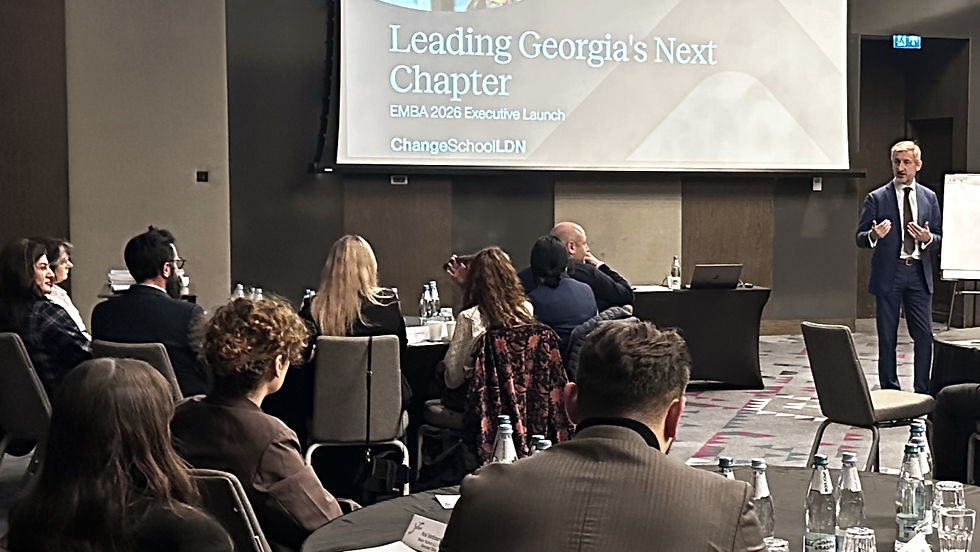
When thirty senior executives gathered in Tbilisi, they came from different industries but faced remarkably similar challenges. Banks, healthcare providers, technology firms, manufacturers, hospitality groups, all were grappling with the same fundamental question: how do you develop leadership capability fast enough to match your organisation's growth?
What emerged from the conversations wasn't theory. It was a clear picture of what actually works when building leadership depth in competitive markets.
The Talent Challenge Everyone Shares
Georgia's talent market is small and competitive. Good people can move. They can be recruited away. They can leave for opportunities abroad.
The organisations in that room have built something substantial—banks serving expanding markets, healthcare groups managing complex operations, hospitality businesses competing internationally, technology firms scaling rapidly, and manufacturing operations growing their exports.
But here's the challenge: the people who built these organisations cannot do everything themselves anymore. Growth demands leadership throughout the organisation, not just at the top. When the external market cannot supply that leadership fast enough, you need to build it internally.
Why Most Leadership Development Disappoints
We led the room through a simple exercise on cognitive biases. One question: 'Is the Mississippi River longer or shorter than 200 miles? Now estimate its actual length.
The anchoring effect was immediate and visible. The initial reference point shaped every subsequent estimate, even among people who understood exactly what was happening to them.
This matters because it explains why so much leadership development disappoints. Awareness does not produce change. Knowing about biases does not prevent them. Understanding a concept intellectually is not the same as being able to apply it under pressure when it counts.
The executives in the room had seen this pattern before. Training that sounds good but changes nothing afterwards. Workshops that generate enthusiasm but not behaviour. Programmes that tick a box but fail to build capability.
Four Pressures Cutting Across Every Sector
The conversation revealed challenges that transcended industry boundaries:
Scaling whilst maintaining quality: Companies that have succeeded now face the challenge of growing without losing what made them successful. More locations, more people, more complexity. The founders and early leaders are stretched. Middle management needs to step up, but stepping up requires capabilities that cannot be assumed.
Internationalisation: Georgian companies are expanding beyond their borders, particularly into Central Asian markets. This creates new demands: cross-cultural leadership, international operations, and managing teams across distances and time zones. The playbook that worked domestically does not transfer automatically.
Generational transition.: Workforces are changing. Younger employees have different expectations about work, communication, and career development. Leadership approaches that worked a decade ago do not necessarily work now. Managers trained in one style must adapt to another.
Transformation fatigue: Every organisation represented is managing some form of transformation—digital systems, operational improvements, market expansion, organisational restructuring. Each transformation demands leadership attention. Delays cost money. Failures cost more. And the leaders driving these changes are already running full-time operations.
The Power of the Peer Network
What struck us most was the quality of the peer group in the room. Leaders from Georgia Capital, IDS Borjomi, Silk Hospitality, ORSON, Nomos Georgia, and dozens more. Different sectors, but facing shared challenges in the same market.
These are people who can learn from each other because they operate in the same context. They compete for the same talent. They navigate the same regulatory environment. They understand the same cultural dynamics.
When executives at this level learn together, challenge each other, and work through problems collaboratively, the network becomes an asset in itself. This is where real development happens—not in isolation, but through structured peer learning with people who genuinely understand your context.

Building Something Lasting
This work would not have been possible without the European Business Association Georgia, the British Council, and the British Embassy, whose commitment to strengthening ties between UK and Georgian business created the foundation for this partnership.
We are grateful to every organisation that contributed to these conversations, including AstraZeneca, Bank of Georgia, TBC, JSC Georgia Healthcare Group, and many others who brought their experience and insight to the room.
Georgian business is asking the right questions. The answers will come from leaders willing to invest in building capability systematically, not just reacting to immediate pressures. The organisations that develop leadership depth now will be the ones that scale successfully tomorrow.
ChangeSchool partners with leading universities and institutions to deliver executive education that develops genuine leadership capability. Our programmes combine rigorous academic frameworks with practical application, delivered through cohort-based learning that builds powerful peer networks.
Learn more about our Executive MBA programme here
Be part of our growing community of innovators and leaders


