
Why Knowing Isn't Changing: The Crisis of Conformity
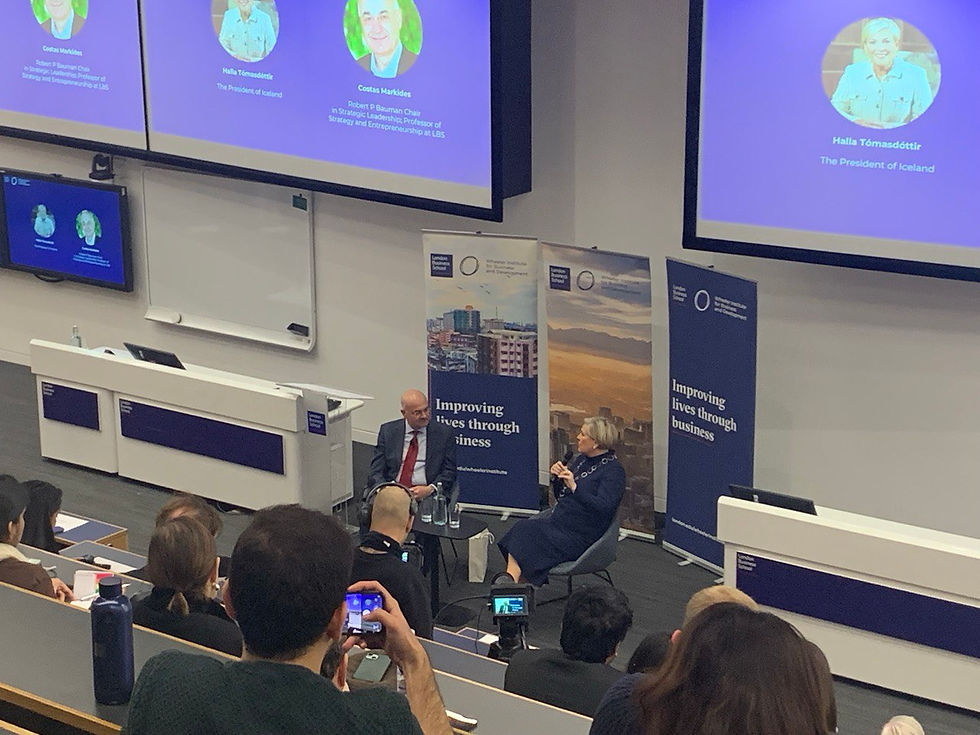
Last week, our Head of Global Partnerships Deepak Semwal attended a conversation with President Halla Tomasdottir of Iceland at London Business School. The discussion raised a question that sits at the heart of leadership development: why is it that we know what needs to change, yet struggle so profoundly to do it?
The event, organised by The Wheeler Institute for Business and Development and led by Professor Rajesh Chandy and moderated by Professor Costas Markides, brought together leaders, academics, and professionals for an honest examination of how business defines success and what it might mean to redefine it. President Tomasdottir's career spans global HR, entrepreneurship, values-driven finance, and work with The B Team before her current role. Her perspective wasn't that of a politician making diplomatic statements, but of someone who has operated across multiple systems and can see their patterns clearly.

The Crisis We Refuse to Name
Early in the conversation, Costas asked a question that cut through the usual discussion of sustainability and purpose: if no CEO disagrees with these noble goals, what actually stops companies from pursuing them? The answer was direct. It's what President Tomasdottir called a "crisis of conformity."
A crisis of conformity isn't about malicious intent or ignorance. It's about systems that shape behaviour so completely that individuals within them cannot imagine alternatives, even when those alternatives are desperately needed. Companies report quarterly because that's what the market demands. Leaders optimise for financial profit because that's how success is measured and rewarded. The problem isn't that people don't understand the limitations of this approach. The problem is that the system makes any other approach feel impossible.
The discussion moved to why businesses exist at all. President Tomasdottir referenced Professor Colin Mayer's work on solving the problems of people and planet profitably, but went further. The issue isn't just adding social and environmental concerns to a financial framework. It's recognising that the current framework is itself the problem. When companies exist primarily to maximise shareholder returns over short time horizons, every other consideration becomes secondary, regardless of rhetoric about stakeholder capitalism.
What struck Deepak most was the recognition that individual leaders, no matter how committed, are constrained by the rules of the game they're playing. The crisis of conformity manifests not as a lack of awareness but as an inability to act differently within existing structures.
Beyond the Quarterly Cycle
One of the most practical points centred on how change might actually happen. The discussion touched on the development of international sustainability standards - work President Tomasdottir was involved in before her presidency. For those who don't know her background, she co-founded Auður Capital, a finance firm built on sustainable values, and worked with The B Team on reshaping global business standards before taking office.
These standards aim to change what companies must disclose and, therefore, what they must manage. When disclosure requirements change, measurement changes. When measurement changes, management attention follows. What gets measured gets managed.
This isn't the inspirational story of transformation we often tell, but it may be more realistic. Real change requires changing systems, not just inspiring individuals.
The conversation touched on time horizons. The quarterly reporting cycle was identified not just as a nuisance but as a structural barrier to the kind of leadership we claim to want. Leaders who try to optimise for long-term value creation while being measured primarily on quarterly performance face an impossible tension.
Some companies have begun addressing this tension by stopping the practice of quarterly earnings guidance. Research shows that companies without quarterly guidance generated nearly 20 per cent annualised growth in market value between 2010 and 2023, compared to just 7.7 per cent for those providing guidance, with most of the world's largest companies having already abandoned the practice.
There were no easy solutions offered to this tension, which felt refreshingly honest. The Well-being Economy Governments partnership, which includes Iceland, Scotland, New Zealand, Finland, and Canada, represents an attempt to learn together what other metrics matter and how to incorporate them into national budgets and policies. But this work is experimental, and its success is far from guaranteed.
Business as Problem-Solver
At several points, the discussion returned to a fundamental question: what is business actually for? The answer was clear: business exists to solve problems. Not to maximise profit in abstract terms, but to create value by addressing real needs in ways that can be sustained economically. This represents a reordering of priorities.
In the current paradigm, profit is the purpose and problem-solving is the means. What President Tomasdottir described inverts this: problem-solving is the purpose, and profit is what enables it to continue.
Costas pushed on the realistic limits of what governments can dictate to businesses. The response focused on the role of government as rule-maker, not as manager of business. Governments should create rules and incentives that align with the future we need, not preserve structures of the past.
When Incentives Work Against Us
President Tomasdottir gave a striking example: during the Ukraine crisis, almost all European governments subsidised energy bills, and almost all of those subsidies went to fossil fuel-based energy because of how existing systems are designed. The amount spent globally on environmentally harmful subsidies, she noted, is six to seven trillion US dollars annually. A fraction of that, invested in the green energy transition, would address climate challenges and reduce geopolitical vulnerability.
This is where the crisis of conformity becomes visible at the policy level. We know the transition is necessary and would be more cost-effective long-term. Yet we continue subsidising the old system because that's where the infrastructure is, where the political relationships are, and where institutional muscle memory tells us to look.
What This Means for Leadership
The conversation raised more questions than it answered, which felt appropriate given the scale of transformation being discussed. How do we create incentives for long-term thinking when capital markets remain focused on quarterly performance? How do we measure well-being without reducing human flourishing to a new set of limiting metrics? How do individual leaders find space to act differently when the systems they operate within reward conformity?
The challenge articulated wasn't about individual leaders becoming more courageous or organisations developing better strategies. It's about recognising that the rules of the game need to change, and that changing them requires coordinated effort across business, government, and civil society.
No single sector can solve this alone. Business cannot regulate itself into long-term thinking. Government cannot mandate well-being without business creating economic models that support it. Civil society cannot shift norms without both policy frameworks and economic structures that reflect new values.
The session opened with the story of Iceland's 1975 women's strike, when 90 per cent of women stopped all work to demonstrate value that had been invisible in how society measured productivity. Five years later, Iceland became the first country to democratically elect a woman as president. This history illustrates that changing how we define success isn't purely a technical or policy challenge. It requires shifts in collective understanding about what counts and what matters.
Systems-Level Thinking
The session was also attended by Otti Vogt, whose thoughtful reflections on the same event offered a complementary perspective. He has been invited to deliver this year's Sir Adrian Cadbury Lecture at Aston University. His analysis focused on the systemic nature of our challenges, highlighting President Tomasdottir's characterisation of GDP obsession as an "intergenerational crime" and the need for leaders who can work on systems, not just within them. His observation about the tension between remaining capitalist while fundamentally reimagining how we measure success points to the complexity of the transition we're attempting.
The Work Ahead
At ChangeSchool London, we have long understood that leadership development isn't just about building individual capabilities - it's about helping leaders navigate and ultimately reshape the systems they work within. The conversation at London Business School reinforced why our approach to executive education focuses on institutional transformation, not just individual training.
The crisis of conformity that President Tomasdottir described is exactly the kind of challenge that requires new ways of thinking about leadership. It's not enough to know what needs to change. Leaders need the tools, frameworks, and support to act differently within systems that actively resist change.
These conversations across sectors and perspectives are essential for building the collective understanding needed to tackle challenges that no single organisation or country can address alone. They remind us that the most important leadership work isn't about having all the answers.. It's about asking the right questions and creating the conditions for meaningful change to take root.
Deepak Semwal is Head of Global Partnerships at ChangeSchool London and a Sloan Fellow and Merit Scholar from London Business School.
ChangeSchool's Executive Education programmes are designed to help leaders navigate and reshape the systems they work within, moving beyond the crisis of conformity to drive meaningful organisational change.
Be part of our growing community of innovators and leaders


